The Metropol as a family
A Gentleman in MoscowThe Metropol as a family describes the community that grows among the hotel’s residents and staff: a household assembled through shared routines, attentive service, private jokes, and mutual care. Its closeness does not erase differences of rank or occupation. Instead, the novel shows people using the roles and ceremonies of hotel life to sustain relationships across those differences—and reveals the family most clearly when its members face departure, absence, and loss.
A Household Made Through Daily Life
The community is built in ordinary rooms and repeated tasks, not in a single declaration of kinship. When Count Alexander Ilyich Rostov returns from his old suite, what stays with him is not its architecture or view but a tea service beside a folded paper. He imagines the resident returning at four, hanging up his jacket, ordering tea and an afternoon edition, and enjoying an unhurried hour before dinner. That small scene represents the liberty of an ordinary domestic afternoon. By contrast, the Count’s assigned room measures only one hundred square feet: its bed crowds the coffee table, the table crowds the chair, and the chair must be moved to open the closet. The contrast makes the hotel’s intimate daily world both shelter and constraint. Its people create a sense of home within circumstances that do not always allow the space, privacy, or freedom of one.
The hotel’s social order is visible in its etiquette. When Manager Leplevsky explains that staff have continued to address the Count with an honorific associated with his former standing, he must ask them to stop because times have changed. The Count accepts the change as part of a gentleman’s duty to adapt. The exchange registers a political and social transformation through a seemingly minor question of address; the hotel family must negotiate new public conventions while maintaining personal regard.
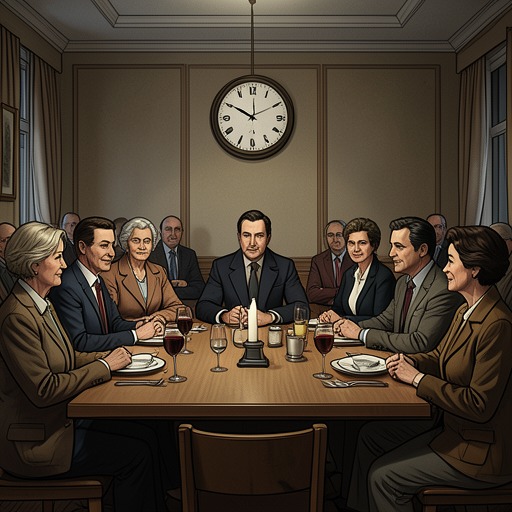
The same care appears in the Count’s attention to service. When a solitary diner invites him to sit, he hesitates because he is dressed to wait upon the table, then accepts the chair without putting the napkin in his lap. The Goliath brings the diner a bottle for approval, and the host thanks him by name as Vladimir. These gestures preserve the distinction between host and waiter even in an intimate meal. Later, the novel makes the Count’s own attentiveness explicit: like an accomplished butler, he hears every exchange around the dinner table while presenting courses, refilling glasses, replacing utensils, and clearing away plates. Service is not merely background labor. It is a way of noticing what others need while remaining discreet, and a practical form of membership in a shared household.
Shared Stories and Remembered Lives
The family’s intimacy is also made of stories that can be retold. At a dinner with Sofia, the Count recalls the commotion he found on the fourth floor in 1946, including Richard Vanderwhile’s salute to a pair of army-issue briefs. The recollection leads to the story of Anna Urbanova throwing her clothes out of a window and having to gather them again in the middle of the night. The stories turn embarrassment and disorder into family lore. The evening is not devoted to advice or grief: the Count has chosen another time for those difficult subjects, leaving this meal for the pleasure of remembering together.
The hotel’s collective feeling becomes visible when Sofia leaves. Arkady and Vasily come from behind their desks to see her off, and Andrey arrives in a tuxedo, Emile in an apron, and Audrius leaves the bar at Shalyapin. They gather around her in a circle of good wishes. Their envy of her journey is described as entirely compatible with friendship across generations: affection does not require them to feel only happiness at her departure. The varied uniforms and workplaces remain in view, but for this moment they form one welcoming group.
Mishka’s legacy makes the relation between friendship and memory more private. After Katerina Litvinova asks that he be remembered, the Count opens a small, amateur-bound volume titled Bread and Salt. Inside is a photograph taken in 1912 at the Count’s insistence: the young Count stands beside Mishka, who looks ready to flee the frame. Mishka had kept the picture despite his earlier chagrin. The book and photograph preserve a friendship in an imperfect, material form, allowing a shared past to remain present after its participants have changed.
Separation, Absence, and Loyalty
The Count’s reading of Bread and Salt brings the family’s warmth into contact with bereavement. A passage from The Brothers Karamazov recalls a dying boy’s request that a crust of bread be crumbled onto his grave so that sparrows might visit. The passage prompts the Count to weep for Mishka, whose generous and temperamental nature had found only a brief moment in time, and for himself. Friends and loved ones remain around him, including Marina, Andrey, Emile, Anna, and Sofia, but Mishka’s death means that the last person who knew him as a younger man is gone. Katerina’s reminder that the Count remains to remember gives memory a social task: a friendship can persist in the living person who carries it forward.
That persistence is tested when both Manager Leplevsky and the Count disappear. Chef Zhukovsky and Andrey Duras, two members of the Triumvirate, meet at 2:15 in the chef’s office. They take comfort from the KGB’s frustration, which suggests that the Count is not in its grasp, but they still do not know where he is. Their concern is not evenly distributed: they spend little time considering Leplevsky’s absence and much more on their friend’s. Rumors that Sofia has gone missing in Paris sharpen the uncertainty surrounding the Count’s whereabouts, linking the hotel’s worry to the absence of someone from the next generation.
The letters that follow turn a disappearance into an intentional parting. Emile and Andrey receive envelopes written in a hand they recognize as proper, proud, and openhearted. Each letter thanks its recipient for his fellowship, recalls the Night of the Bouillabaisse, and includes four gold coins as a token of lasting friendship. The men open and read their letters together, then drop them on the table together. Emile’s joy at the coins and the news that an old friend is deliberately at large soon gives way to anxiety about life without the Count and with Andrey supposedly afflicted by palsy. Andrey answers that his hands remain agile. The exchange is comic, but its question is serious: the hotel’s family must discover how to continue its shared work when one of its central members is gone.
Family Beyond a Fixed Place
The novel presents the hotel community as durable but not unchanging. Its bonds are made visible through manners, work, jokes, objects, and acts of farewell; none depends on keeping every member in the same room. The community remembers the Count’s earlier life in stories, honors friendship through Mishka’s book and photograph, and expresses affection in the circle gathered around Sofia. When absence arrives, letters and recollection carry relationships beyond the hotel’s immediate routines.
The Count’s return to the ruins of his old home offers a parallel image of attachment after change. The mansion has burned down, leaving two leaning chimneys and ash in the clearing, yet he meets the altered landscape with a wistful, serene smile rather than despair. The scene does not make the hotel and his childhood home identical; it extends the article’s central distinction between a place and the relationships or memories associated with it. The Metropol’s familial character lies less in an unaltered building than in the people who attend to one another, remember shared lives, and continue their work after someone leaves.